When people talk about how much plastic pollution there is in the ocean, they tend to focus on a things:
- Straws
- Toothbrushes
- Plastic bottles
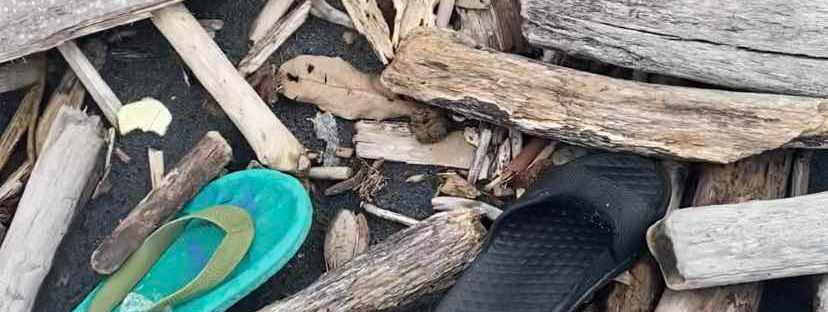
This past week, our family helped out with several beach cleanups at the Gandoca beach – one of the most important sea turtle nesting sites in Costa Rica. We were prepared for the volume of trash (there was SO MUCH), but we were very surprised by one item that we found way more of than anything else:
SHOES!
The amount of flip-flops, in particular, on the beach was mind-boggling. There were flip-flops everywhere!


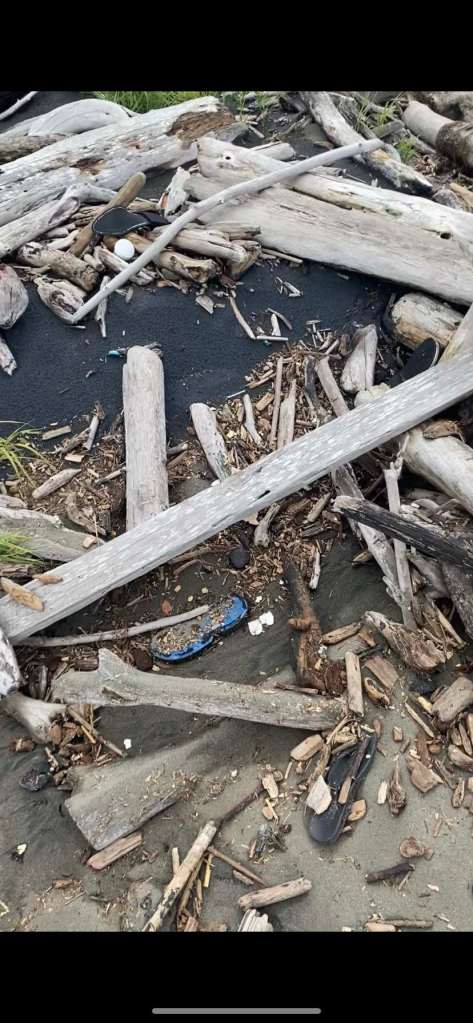
After just 30 minutes of cleaning a 50-foot length of beach, we had a large black trash bag almost completely full of trash, and it was almost all flip-flops.
It was so discouraging to see our discarded shoes covering such precious beaches, where the giant leatherback, hawksbill, and green sea turtles make their perilous, incredible journeys to lay their eggs.


Every time we attend a trash cleanup, we are reminded of the “sinking ship” analogy. It’s futile to try to bail water out of a sinking ship (trying to clean up the world’s plastic trash). The long-term solution is to plug the hole (stop producing plastic in the first place).
So — how do we do that with shoes?
Zero waste shoes
As with anything zero-waste, we need to follow the hierarchy:

Applying this framework to shoes, here’s some questions that come to mind:
- Rethink / Redesign
- What if shoes were fully biodegradable, so that when they’re worn out, we could compost them?
- What if shoes were built to last longer before they needed to be replaced? (especially flip flops and sandals)
- Reduce
- Why do people buy so many shoes? How might we change our relationship to shoes, to change our perception that we need to buy so many of them? Buying fewer shoes would also allow us to afford more well made shoes. Before going zero waste, Sadie would often spend $20-30 each year on a pair of winter boots that would fall apart by the next year. Spending more on a pair that lasts a long time not only saves money, but also reduces the amount of shoe related waste. (And if you can find a well made shoe second hand, it is still only $20-30!)
- Reuse
- Could we give discarded shoes a second life? Many shoes I found on the beach were still functional. What markets are there for “previously loved” shoes?
- After shoes are no longer functional as shoes, could we use them as something else? How might we up-cycle shoes and use them for a different purpose?
- Recycle/Compost
- This connects to Redesign – in their current state, shoes are landfill-bound by design, as they are difficult to disassemble, and their component parts are generally plastic or difficult to recover.
Considering these questions, we found a number of interesting answers!
Second-hand shoes
The market for second-hand shoes has exploded in recent years with the advent of sites like Poshmark, thredUP, and of course old standbys like eBay, which make it easy to resell gently-used but still-functional shoes of any types.
Thinking more locally, there’s always local thrift stores and consignment sales, which are fantastic places to find inexpensive pre-owned shoes. So far, we’ve been able to find more than 98% of our children’s shoes from consignment sales, where prices for used shoes are mere dollars.
Repair / resale
Often, shoes get discarded before they are fully worn out. What are some solutions to this?
- Resale – as described above, there are lots of places to resell your shoes and recoup some of our investment, especially if you purchased high quality shoes with high resale value.
- Repair – sometimes you can repair an issue yourself, or have a company repair them for you.
- Chattanooga: Buddy’s Shoe Repair in Hixson is the only local place we know of. Sadie bought a pair of nice boots from a thrift store, and then had Buddy’s resole them when the sole wore out, and it was like getting a pair of new boots (if you know of other places, please let us know in the comments!)
- National: Chaco‘s ReChaco program lets you send your shoes back to have them repair / replace the parts that are broken or worn out to extend the life of your shoe.
Eventually, though, shoes wear out.
So – what can you do with a truly worn-out shoe?
Some footwear companies offer take-back programs, but it’s not always transparent what they do with your shoes as part of their promises for “responsible disposal”.
Upcycling
Many people have found creative ways to reuse shoes in completely different ways, such as:
- Planters
- Stepping stones / pathways
- Pillows (especially for leather shoes)
Google “repurpose old shoes” and you’ll find lots of interesting DIY ideas for reusing old shoes, or at least parts of them.
But when all options are exhausted – eventually, shoes get discarded.
Which brings us back to the first step of the zero waste hierarchy – how might we redesign shoes to create a more circular lifecycle for them?
Biodegradable shoes
After picking up so many sandals and flip-flops along the ocean, we were particularly discouraged because in the small community of Gandoca where the trash pickups were held, there is no municipal waste management — all trash is burned in backyard piles. This is extremely common in much of the world, and from a purely financial perspective, is a far cheaper option.
However, it’s well-known that incineration of plastic waste produces extremely toxic byproducts such as dioxins, which have been directly linked to cases of asthma and other diseases in communities near incinerators. (If you want to learn more about this, watch “The Story of Plastic”).
Which means – that all the sandals and flip-flops we were picking up were just going to be burned!
This sad reality drove us online to search for alternatives – there’s got to be smart people out there who have figured out how to make biodegradable shoes by now!
Sure enough – there are!
In the last decade, a flurry of innovative companies have releases fully or near fully-biodegradable footwear options. We’ll just list a few here, but by the time you read this, there will almost certainly be more!
- Balena – in 2022, this company released their Balena Slides using their BioCir elastomer, which they hope to use for other applications beyond shoes.
- Blueview Footwear – This company spent 6 years researching a sole material that would rapidly biodegrade in industrial composting conditions, and they have both published peer-reviewed research explaining their methods and received independent third-party verification that their shoes fully biodegrade in less than 1 year in industrial composting facilities. CEO Stephen Mayfield is a distinguished professor of biology at UC San Diego and has a particular interest on using algae as the source material for these shoes.
- Orba Shoes – This New Zealand company has put a ton of thought into every material used in their shoes. All components are either fully biodegradable or naturally occurring.
There’s so much potential for the shoe lifecycle to move from linear to circular – we need to see companies like these scale up their operations globally and receive enough adoption to nudge the global titans like Nike and Adidas to adopt similar methods.
Here’s to a brighter, zero-waste future for shoes, for the sea turtles, and for us!
💡🩴 🐢 🌎


 Zero Waste Chattanooga